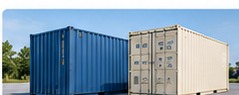
Have the supplier approve the entire approach, unloading area and final position before you order. A container's footprint is much smaller than the working area a delivery truck needs. Clearance figures must match the carrier, vehicle and delivery method.
Tilt-bed, flatbed or crane placement?
Tilt-bed delivery slides the container off an angled bed. It commonly avoids separate lifting equipment at straightforward sites, but needs alignment and clear run-out. Flatbed delivery carries the unit to site and requires an arranged unloading method.
Crane-assisted placement can solve some positioning problems, but the crane still needs access, suitable ground and a lift plan. A constrained site does not become suitable merely because a crane is involved.
| Method | Confirm with the carrier |
|---|---|
| Tilt-bed | Straight unloading space, slope, overhead movement and exit |
| Flatbed | Who supplies and coordinates unloading equipment |
| Crane / side-loader | Access, working area, reach and ground suitability |
| Customer collection | Depot rules, suitable vehicle and destination unloading |
Why a single clearance number is not enough
Eveon's delivery page gives an approximate tilt-bed example of 80–100ft of run-out and a minimum 14ft overhead approach clearance. These are supplier examples, not a universal approval for a 40ft delivery, raised-bed movement, crane operation or your site.
Ask the actual carrier for written length, width, turning and overhead requirements. Confirm where each measurement applies: approach, alignment, unloading or departure. Supply photographs if a bend, slope or obstruction is difficult to describe.
Walk the route from the public road
Measure the narrowest gate opening rather than the apparent driveway width. Consider the turn from the road, parked vehicles, fences, trees, soft edges and any structures the vehicle must pass. The truck's swept path may need more room than a straight vehicle width suggests.
Tell the carrier about slopes, drainage crossings, recently disturbed ground, septic systems, buried services and surfaces that may not support the vehicle. Keep clear of overhead electrical hazards; have the carrier and utility address those constraints rather than attempting to alter wires.
Agree on position and door orientation
Mark the container corners and show which way the doors should face. Check that door swing and routine loading will work once fences, other containers or stored materials are back in place.
Ask whether the requested orientation changes how the unit must be loaded on the truck. Agree the location before dispatch. Repositioning after unloading may require another visit or specialist equipment.
A delivery-day checklist
Have an authorized receiver present with the order and supplier contact details. Keep the work area clear of people and vehicles, and let the carrier direct the unloading operation. Avoid walking beneath or beside a moving suspended or sliding container.
- Confirm the marked position and orientation with the driver.
- Verify that the prepared support arrangement is ready.
- Inspect the delivered unit and photograph concerns.
- Operate the doors after placement.
- Record defects through the supplier's acceptance procedure before the driver leaves.
Ask about unsuitable-site charges upfront
Understand the consequences if rain, access or ground conditions prevent unloading. Ask who decides whether the delivery can proceed and how waiting, redelivery or alternative placement is charged.
If the site changes after approval, contact the supplier promptly. A muddy approach or newly installed gate can invalidate the original plan. Getting the plan updated is easier than solving it with a loaded truck outside.
Common questions
Is a 40ft clear area enough for a 40ft container?
It may fit the stationary box but not the truck and unloading movement. Get the carrier's full space requirements.
Can the driver place it over a fence?
Do not assume so. That requires an appropriate handling method, suitable equipment and an approved site-specific plan.
Sources & approach
Technical references and supplier guidance used for this guide. Recommendations and worked examples are EzyTrader’s editorial analysis; supplier-specific requirements still need confirmation.
Images are illustrative, not available inventory. Read our editorial approach.